Portland, OR · Garage Door Service
Aloha's garage doors mostly date to the early 1980s steel-sectional era. We travel from Portland to swap worn rollers on these original tracks and hardware.
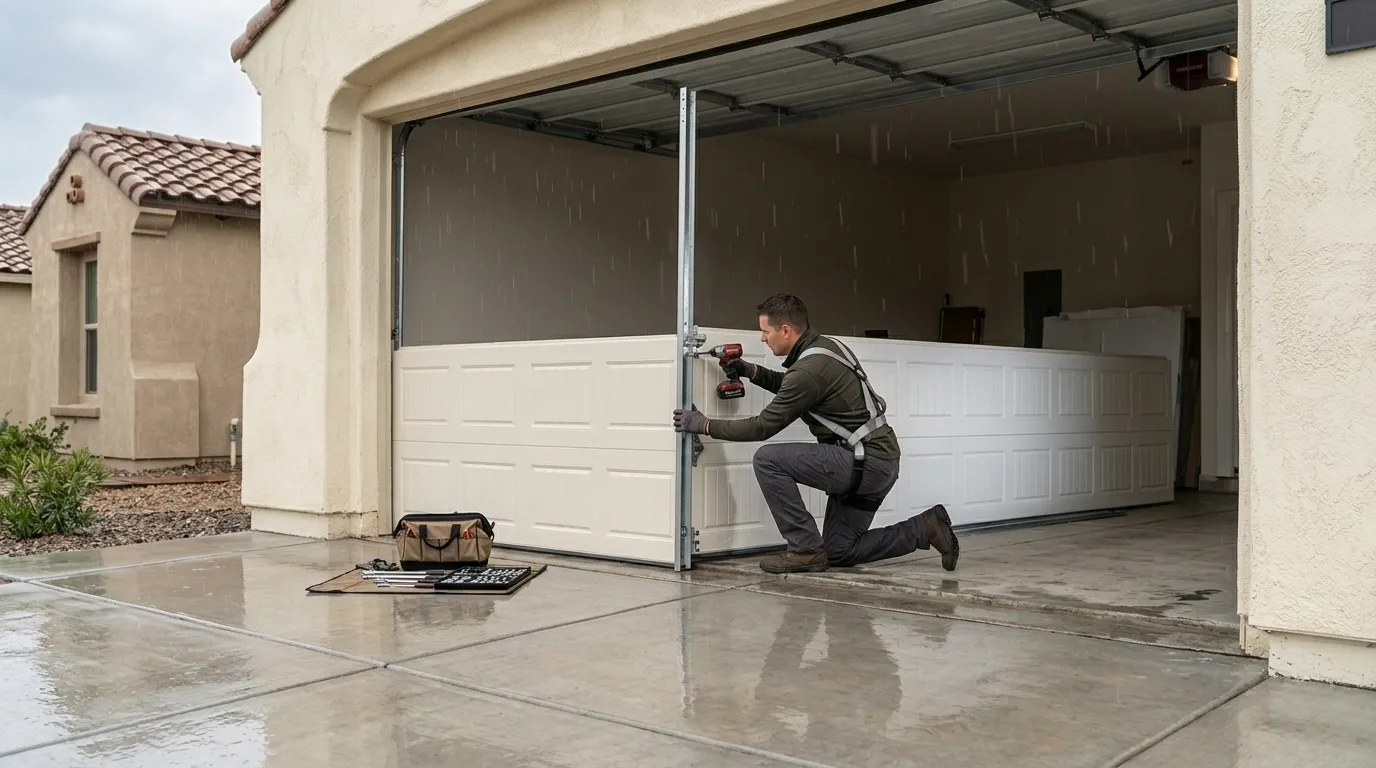
Most garages in Aloha went up around 1983, and the door hanging in that opening today is very often a steel sectional door original to the house - 16x7 for a two-car bay, single layer, hung on steel tracks with the roller stems set into the panel hinges. After forty-plus years those stems wear oval instead of round, and the rollers themselves - usually the stamped-steel 7-ball kind that shipped standard back then - chip, flat-spot, or lose their bearings entirely. That's the grinding or the door that hangs up two inches from full close.
We pull the door to its open travel, block it, and work one roller at a time so the door never sits unsupported on the track. On a door this age we're almost always finding bent roller stems and worn track flanges alongside the rollers themselves, so the job is really three checks in one: roller, stem, and the track it rides in. If the track has worn to an hourglass shape at the roller path, no roller - new or old - will run quiet in it, and we say so before we start swapping parts that won't fix the actual noise.
For a door built to early-80s spec, we stock nylon rollers with sealed bearings in the stem sizes that fit that era's hinge punching - they're quieter than the original steel rollers and don't need the yearly grease that steel demanded. We also carry the roller stems separately, because on a door this old the stem is usually the actual failure point even when the roller looks fine.
What we don't stock on the truck: rollers sized for the newer, thinner track profiles that show up on doors installed in the last decade or so in this same area. If your house is one of the newer builds mixed into Aloha's stock, we may need to order that stem size rather than swap it on the spot - worth knowing before you book the call so you're not waiting on us mid-driveway.
We don't quote a number sight unseen, because the range on this job depends entirely on how many rollers are bad and whether the track needs straightening or replacing alongside them. A door with two or three worn rollers and clean track is a short job. A door where the stems are bent and the track flanges are chewed from years of a flat-spotted roller running through them is a longer one - you're paying for track work, not just parts.
One honest note: if you're at the point where more than half the rollers on a 1983-era door are original steel and failing, and the track shows wear to match, it's often cheaper over the next few years to replace the full roller set in one visit than to keep paying a truck fee to swap one roller at a time as each one fails.
The mistake we see most in Aloha is a homeowner replacing the rollers but not the stems, because the stem looks straight to the eye. On a door built in the early 80s, forty years of a heavy steel roller pulling sideways on that stem leaves a bend you can't see without a straight edge against it. New roller, same bent stem, same noise inside a month.
The other one: buying generic rollers sized for today's lighter aluminum-track doors and forcing them into an older steel track. They'll go in, they'll turn, and they'll bind under load the first cold morning because the stem diameter and the track gap were never matched. On a door this age, matching the roller to the actual track profile matters more than the roller brand.
Aloha sits in the mild-with-occasional-freeze band that covers this side of the metro, so the rollers here aren't fighting the deep-freeze swings you'd get further inland - they're failing from age and cycle count, not from ice cracking a bearing. Eleven miles out from Portland, the housing stock here runs a fair bit newer than the close-in neighborhoods, but that early-80s median build year still means a lot of original steel-roller doors are past their working life on the same schedule, most of them all failing within a few years of each other rather than staggered.
With roughly 18,790 households in the area, that clustering shows up as a real pattern: a run of roller calls from the same few subdivisions in the same season, because the doors went in the same year and are wearing out the same part at the same time.
Run the door slowly and watch the roller path. If the noise or catch happens at the same spot every time, it's usually the track - a dent or worn flange. If it's steady grinding through the whole travel, that's the roller bearing itself. On a door from the early 80s we usually find some of both.
You can, and for a door with mostly good rollers and one bad one, that's the right call. But on an original-hardware door from this era, if one steel roller has failed from age, the others are usually close behind - worth checking the full set while we're there rather than making a second trip.
Sometimes. Steel rollers get loud years before they actually fail, so a quiet-running swap to sealed nylon rollers often solves noise on its own. If the noise is coming from a bent stem or worn track instead, the rollers alone won't fix it - we check both before we quote the job.
Yes, we work this job out of Portland and cover Aloha as part of our service area. There's no local branch here, so the visit is scheduled from Portland rather than dispatched from a depot in town.
Call now or request a free quote - same-day service on most repairs, upfront written pricing.