Portland, OR · Garage Door Service
Bethany's commercial buildings mostly date to the 1990s and early 2000s, meaning sectional steel doors on standard torsion springs. Portland Garage Door Pros services this stock, 9 miles out.
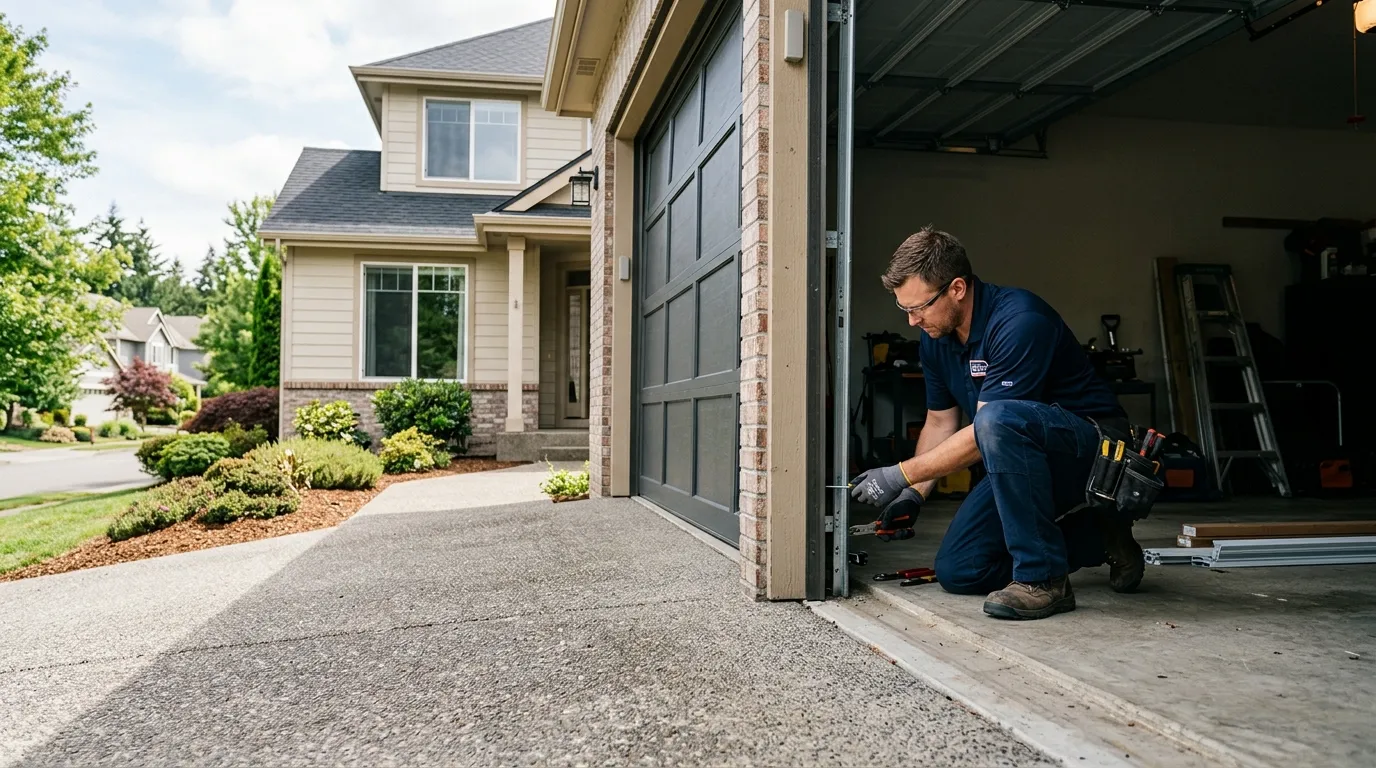
Bethany sits about 9 miles from our Portland base, and the commercial buildings out here mostly went up alongside the neighborhood's own housing boom - later than most of the areas we cover, closer to 2003 than to 1982. That matters for parts. A building this age almost always has a sectional steel door on a standard torsion spring setup, not the older extension-spring or side-mounted torsion hardware you find in older commercial strips closer to the city. We carry torsion springs sized for typical commercial door weights, standard-lift and high-lift track sections, nylon and steel rollers, galvanized cable, and commercial-grade openers built for higher duty cycles than a residential unit. What we don't stock on the truck is anything custom - a non-standard door width or a specialty insulated panel from a builder who's since gone under. That's a special-order part, and it can mean a wait. On a building this era, though, that's the exception, not the rule. Most jobs out here are straightforward swaps on hardware that's still in production, which keeps both the part and the trip predictable. We bring what a 2003-era commercial door needs as standard stock, because that's what we find, over and over, on this side of the metro.
We don't quote a number here without a fact behind it, and we don't have a published price list for this specific job. What we can tell you is what drives the number when we do quote it: torsion springs rated for a heavier commercial door cost more than residential ones, and a high-lift track conversion runs longer than a standard swap. Bethany's median household income sits at $164,315, well above the wider service area's $102,931, and the buildings here tend to be newer construction rather than a patched-together older structure - which usually means less surprise labor once we're inside the header. That doesn't set your price, but it does mean fewer of the hidden-cost problems that come with retrofitting old brackets onto framing that was never built for a torsion system. Ask for a walk-through quote before the job starts. A door this age, with standard hardware still in production, is usually the cleaner estimate to give - and the cleaner one to hold to.
The failure we see most on newer commercial buildings like the ones in Bethany isn't hardware failure - it's cycle count. A door built in the early 2000s for a business that ran one shift a day, now running two or three shifts, wears out springs and rollers faster than the original install ever accounted for. The other place this goes wrong is a mismatched opener: someone swaps in a residential-grade unit to save money on a commercial door, and it burns out inside a year because it wasn't built for the duty cycle. Neither of these is dramatic when it happens - the door just gets slower, then louder, then it doesn't open one morning. Because the housing and commercial stock in this part of the metro mostly dates to the 1980s through the mid-2000s, the failure mode is close to what you'd expect from any well-built structure of that vintage: fatigue on parts that were never oversized to begin with, not the total hardware mismatch you get retrofitting a torsion door into 1940s framing.
We travel from Portland to reach Bethany, about 9 miles, so factor drive time into when the crew shows up rather than treating it as a same-hour call. Once on site, a straightforward spring or roller replacement on standard commercial hardware - the kind we expect to find on a building from this era - is a same-visit job. An opener swap on standard-duty equipment is also usually one visit. What extends the timeline is anything custom: a non-standard door width, a specialty panel, or a part that has to be special-ordered rather than pulled off the truck. We won't promise a same-day fix on a part we don't have, and on a job like that we'll tell you the wait up front rather than guess.
A commercial torsion spring holds a lot more tension than a residential one, and that's not a job to take on without the right bars and clamps - the honest answer is don't. Where a building owner can genuinely help themselves: keeping an eye on cycle count if you've added shifts, listening for the door getting louder or slower before it fails outright, and not letting a residential-grade opener get installed on a commercial door just because it's cheaper upfront. Beyond that, on a building this size, with hardware rated the way commercial doors are rated, this is a call-a-crew job, not a Saturday project.
No. We run this job from Portland, about 9 miles away. There's no local depot here, so plan for drive time as part of scheduling rather than expecting a same-hour response.
Newer, generally. The area's own housing dates closer to 2003, later than the broader service area's median of 1982, which points to more standard sectional-door hardware still in production and fewer retrofit surprises.
Sometimes, but not off the truck. Standard commercial hardware is stock for us. A custom panel width or discontinued insulated panel is a special order, and we'll tell you the lead time before we start rather than promise a date we can't hit.
Call now or request a free quote - same-day service on most repairs, upfront written pricing.