Portland, OR · Garage Door Service
Commercial garage door repair and install for Tigard businesses, built mostly through the 1980s-90s boom, serviced by a crew that drives out from Portland.
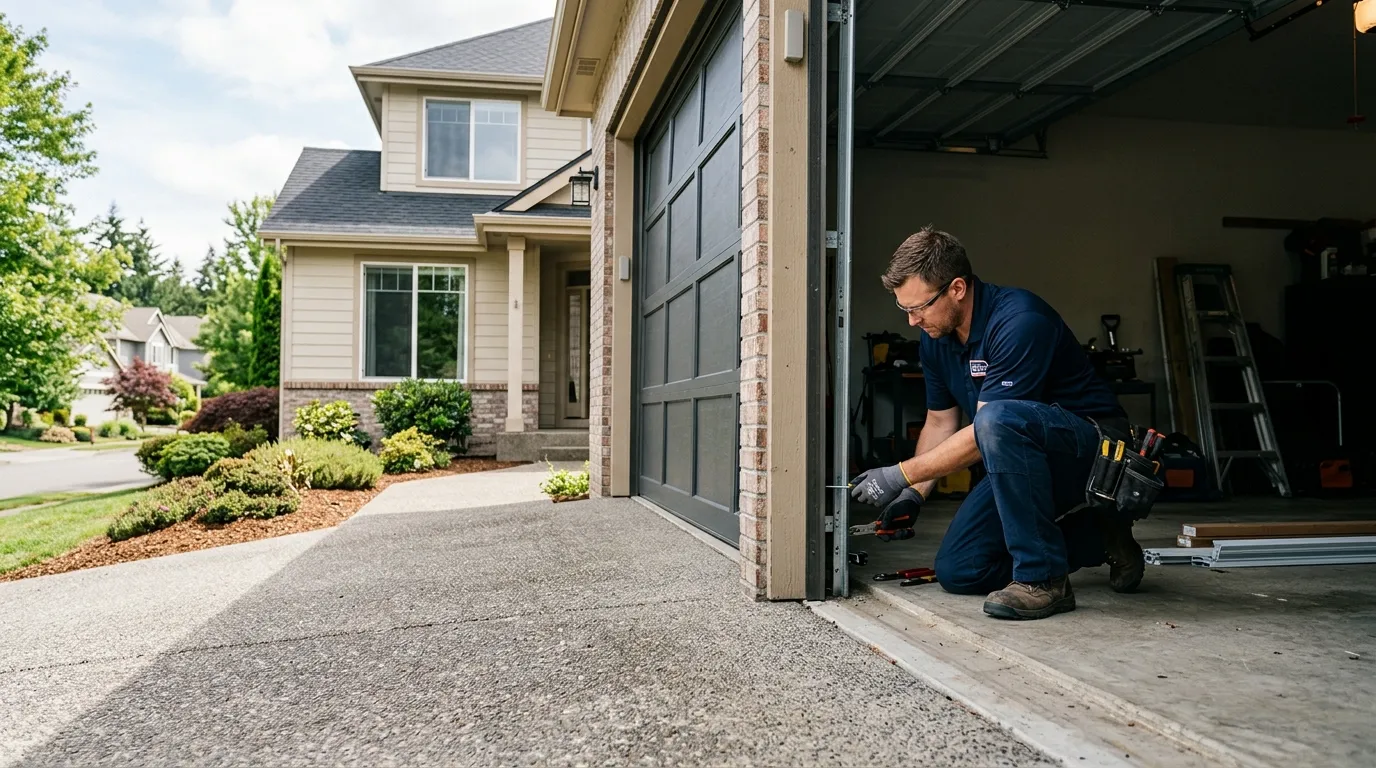
Tigard has 22,635 households, which puts it among the larger suburbs the crew drives out to from Portland, and that size shows up in the mix of commercial calls: warehouses, small flex-industrial units, retail strip backs, all with roll-up doors that see heavier daily cycles than a home garage ever will. Most of the wider service area's housing stock runs a median build year of 1982, but Tigard itself centers closer to 1988 - later than that regional median. A building put up in the late 1980s is now on its second or third opener motor if nobody's kept records, and the original torsion springs, if they're still in, are well past the cycle count they were rated for. On a commercial door that gets opened dozens of times a day instead of two or three, that spring failure doesn't wait for a slow month. It happens mid-shift, with a truck backed up to the bay and nowhere for it to go. The other thing that shows up in this window of construction: steel track mounted with hardware nobody stamps anymore in the same gauge, which means a repair sometimes means sourcing a compatible part rather than a stock one.
We don't guess at any of this without seeing the door - this section is about what the numbers predict, not a diagnosis.
The crew works out of Portland, about 10 miles from Tigard depending on where the building sits, so a visit here isn't a walk-across-town job - it's scheduled like any other stop on the route. That's not a knock against the town; it just means there's no branch office or standing truck parked in Tigard, and we won't pretend otherwise. When you call, have the door's approximate age or the building's construction year on hand if you know it - given how much of Tigard's commercial stock lines up with that late-1980s window, that single number tells us more about what's likely wrong than a description of the noise usually does.
Commercial accounts should also flag whether the building has more than one bay door, since a multi-door site changes what gets loaded on the truck before it leaves Portland. We'd rather bring the right spring and roller stock the first trip than make a second run for a part we should have carried out the first time. If a part isn't something we stock - certain older commercial-grade openers, for instance - we'll say so on the call rather than after the truck's already there.
There's no fixed number here, because a commercial door job in Tigard depends on what's actually failed and whether the part is common stock or something we have to track down. A broken cable or a burnt-out roller chain on a door installed sometime after 1988 is usually a same-visit fix, since that era of commercial hardware is still widely made. An opener control board on the other hand, especially on a unit that's original to a building from that period, can mean a wait if the manufacturer has moved on to a newer line and the board has to be sourced rather than pulled off a shelf.
Weather plays a smaller role here than it does in colder parts of the country - the region sits in a mild climate with only occasional freeze conditions, so we're not fighting frozen track or ice-locked seals on most calls, which keeps diagnosis straightforward once we're on site. What takes the time is usually parts availability, not the weather and not the drive from Portland.
On commercial doors in Tigard, the complaint we hear most is a door that's slow to close or reverses partway down - on buildings from the late 1980s window, that's often a photo-eye sensor knocked out of alignment or wiring that's been patched more than once over the decades, not a dramatic mechanical failure. A door that's suddenly heavy to lift by hand, or that a motor strains against, points toward a torsion spring losing tension - expected on hardware that's been cycling since the building went up.
Rust streaking near the bottom panel or track shows up occasionally even in this mild climate band, usually where water pools against a slab rather than from hard freeze damage. And a door that slams the last foot of travel instead of settling is almost always a spring problem, not a track problem, no matter how loud the track sounds when it happens. None of this replaces a look at the actual door - these are the patterns that hold across a lot of the buildings in this part of the service area, not a diagnosis for any one address.
Some of it, yes. Lubricating rollers and hinges, tightening loose bolts on the track brackets, or swapping a worn weatherstrip along the bottom panel are all reasonable owner jobs on a commercial door same as a residential one. Torsion springs are not on that list - a spring under tension on a wider commercial door carries more stored force than a garage door spring, and we don't recommend an owner or maintenance crew handle that without the right bars and clamps.
Opener logic boards and photo-eye alignment are usually a five-minute fix for someone who's done it before and a frustrating hour for someone who hasn't, so that's a judgment call based on your own patience. If the building's original opener dates back to when the property was built in the late 1980s, replacement parts for it may simply not be made anymore - at that point the honest answer is a new unit, not a repair, and we'll tell you that rather than bill for a part search that won't turn up anything.
No. The crew works out of Portland and drives out to Tigard for each call, about 10 miles depending on the address. We don't run a standing Tigard depot, so we schedule visits as part of the route rather than promising a fixed same-day window.
Tigard's commercial stock centers around a build date near 1988, later than the roughly 1982 median across the wider service area. That later date usually means different opener generations and hardware gauges than older buildings closer to Portland, which changes what part we bring on the truck.
It helps. The region sits in a mild climate band with only occasional freeze conditions, so we're not dealing with ice-locked track or frozen seals often. Most of what fails on a Tigard commercial door is cycle-driven wear from daily use, not weather damage.
Sometimes. If the opener is original to a building from the late 1980s, the exact board or motor may no longer be made, and sourcing a compatible replacement can take longer than a standard repair. We'll tell you upfront if that's the situation rather than guess.
Call now or request a free quote - same-day service on most repairs, upfront written pricing.