Portland, OR · Garage Door Service
Tigard homes built around 1988 still run steel rollers on steel track. We travel from Portland to swap them for sealed nylon before the track wears out.
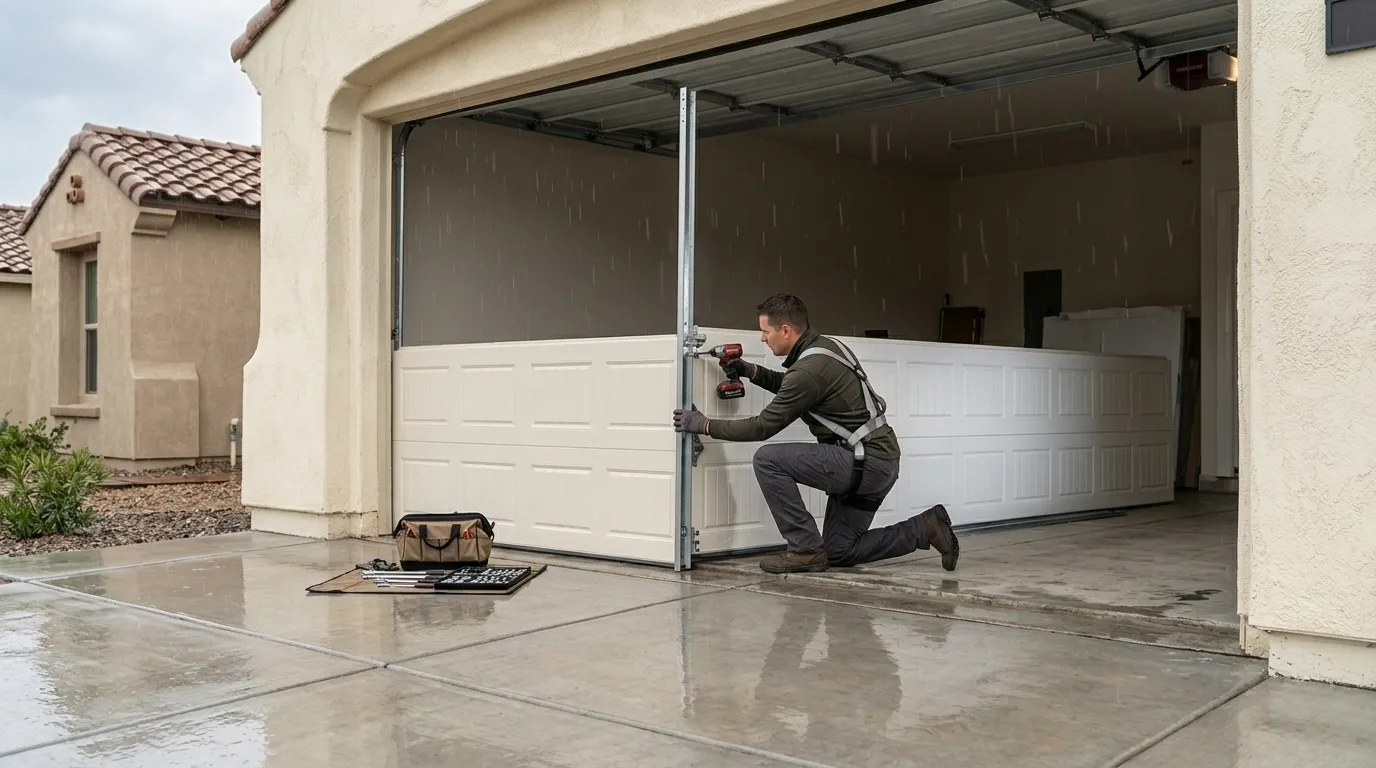
Most of what we replace in Tigard is steel rollers on steel track, because the bulk of the housing stock here went up around 1988. That generation of door came stock with 7-ball steel rollers riding directly on steel tracks with no bearing insulation. They're loud from day one and they get louder as the metal-on-metal contact wears a groove into the track rail. The failure people call about isn't usually a roller popping out - it's the track itself, worn oval instead of round, from ten-plus years of a bad roller grinding against it.
By the time an owner notices the door is louder than it used to be, the roller has usually already started chewing at the track edge. Swap the roller alone at that point and the new one still rattles, because it's riding in a track that's no longer straight. That's the trap on a house this age: the roller looks like the whole job, but the track is often part of the bill too. We check both before we quote either.
We run this job out of Portland, about 10 miles up the road, so there's no branch or depot sitting in Tigard - just a truck that comes to you. Tell us the door's noise pattern when you call (grinding at the top of travel, catching partway, or steady rattle the whole run) and we can usually tell you over the phone whether you're looking at a roller-only job or a roller-and-track repair.
We don't quote a fixed response time for this area since the drive from Portland varies with traffic, but we'll give you a window when you book, not a vague callback promise.
A straight roller swap - all ten rollers, no track work - is usually done in under an hour once the truck's in the driveway. Add track straightening or replacement on one or both sides and you're looking at closer to two hours, since the door has to come off the track partway to get it done right.
We don't stock every track profile on the truck for every door width, so if your door is an odd size or the track is bent badly enough to need a full section rather than a straightening, that piece sometimes has to be ordered. We'll tell you on site if that's the case rather than guess.
Grinding or squealing that gets louder over months, not weeks, is steel rollers wearing against steel track - the standard combination on a house built around the late 1980s here. A door that catches or jerks at the same spot in its travel every single time usually means a specific roller has failed or a track section is dented at that point, not a general lube problem.
If the door sounds fine at the bottom of the run but grinds hard near the top, that's often the roller closest to the spring side, since it carries more load on the last foot of travel. Oregon's mild, occasional-freeze climate (per federal climate data for this region) doesn't crack rollers the way a hard freeze-thaw cycle would, so if yours are failing early it's more likely wear from age than weather damage.
Swapping a single roller on an unloaded door - meaning the spring is intact and holding tension normally - is within reach for a careful homeowner with the right roller size and a couple of vice grips to clamp the track. Where it gets dangerous fast is if you're also dealing with a broken spring or bent track, because then the door isn't holding position the way it should, and working near it isn't the same job.
We'll be honest that track straightening is not a DIY task we'd recommend - it takes a feel for how much the rail will bend back before it kinks, and a rail that kinks instead of straightens has to be replaced, which costs more than if you'd called first.
Oregon's climate here runs mild with occasional freezes, so it's rarely the cold itself. More often it's that grease has thickened slightly and the roller-to-track wear that's been building all year is just more audible once other outside noise (open windows, yard work) drops off in winter.
Standard 7-ball steel and nylon rollers are stock items we carry. Odd track widths or a track section that needs full replacement rather than straightening sometimes has to be ordered, and we'll tell you on site if that's the case.
If the door itself is straight and the panels are sound, roller and track repair is usually the cheaper fix and holds up fine. We'd only steer you toward full replacement if the panels are dented or rusted beyond the track issue.
A groove or shine worn into the metal track rail, visible if you look closely at the rail's inner edge, means the track's involved, not just the roller. We check both on every call rather than assume.
Call now or request a free quote - same-day service on most repairs, upfront written pricing.