Portland, OR · Garage Door Service
West Linn median income tops $138K, and most houses here date to the late 1980s. See why that changes the repair-or-replace call before we ever pick up a spring.
West Linn's median household income runs about $138,526 - well above the roughly $102,931 median across the wider Portland service area. That number matters more than it sounds like it should, because it changes where the repair-or-replace line sits. A homeowner at this income level often isn't trying to squeeze one more year out of a 1980s door; if the torsion spring is gone and the drum is scored, replacing the hardware outright is usually the better math than patching a door built when Reagan was in his second term.
That said, plenty of things you can look at yourself before calling anyone. If the door won't move and the opener light is blinking, check the manual release cord - it may be in the disconnected position from a power outage. If a cable has jumped the drum but hasn't snapped, do not touch it; that's stored spring tension and it can take a finger off. Anything involving a torsion spring, a broken cable, or a door that's come off its rollers is not a DIY repair. We travel from Portland to reach West Linn, so if you're unsure, it's worth a call before you spend an hour on something dangerous.
Most West Linn houses were built around 1988, which puts them squarely in the era of steel sectional doors on extension or early torsion spring setups - sturdier than the one-piece doors from the 1960s, but the springs, cables, and rollers on a 35-year-old system are original parts nobody manufactures the same way anymore. When we get a call for a dead door, we're usually replacing a spring, a cable, or a section of track rather than fighting old hardware back into alignment.
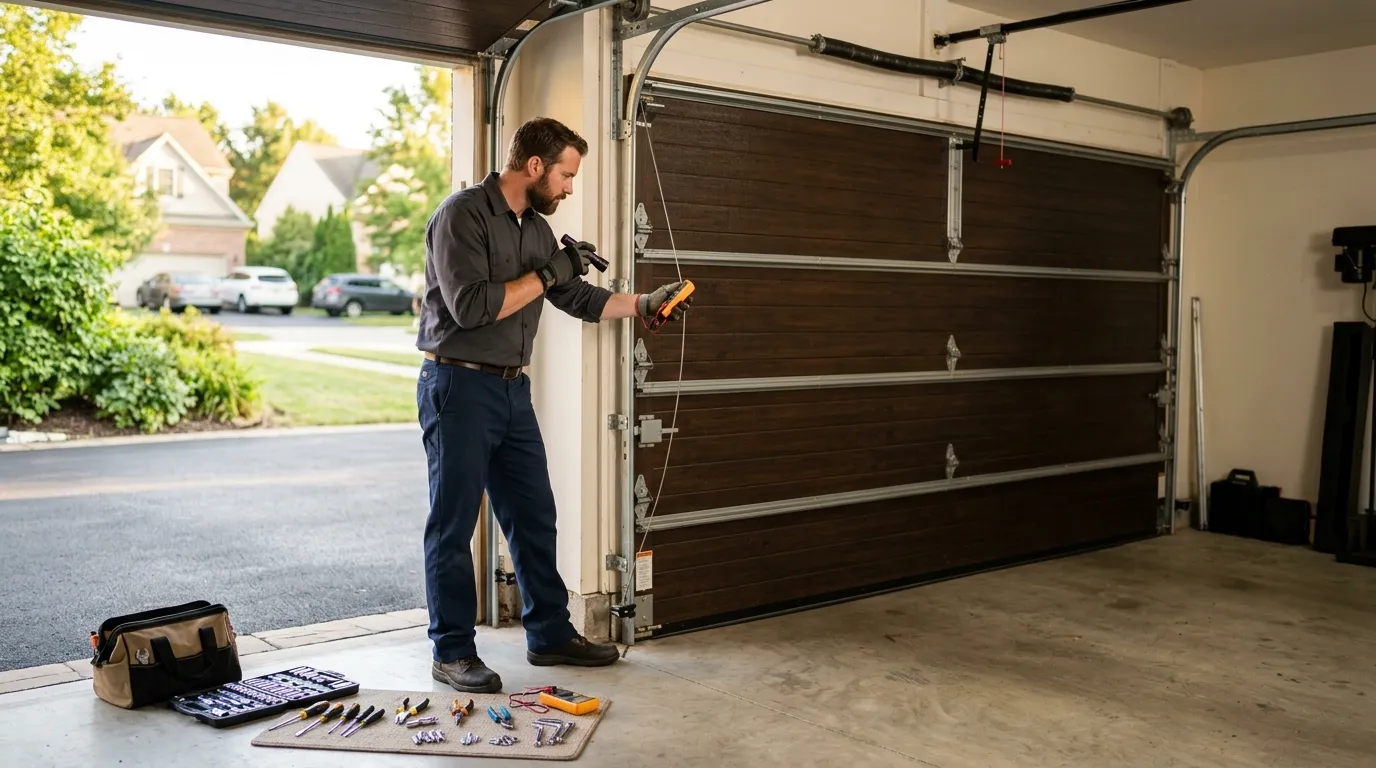
We check the springs first, since a broken torsion spring is the most common reason a door won't lift. Next we look at the cables and drums, then the rollers and track alignment. If the opener itself has failed rather than the door hardware, we test the logic board and the sensors before assuming the motor is the problem. We carry common spring sizes and cable lengths on the truck, so most of these jobs close out in a single visit. What we don't do is force a fix on a door that's structurally shot - if the panels are rusted through or the frame is bowed, we'll tell you straight instead of bolting a new spring to a door that won't hold it.
A door that slams down instead of lowering under control almost always means a broken torsion spring - the spring normally counterbalances the weight of the door, and without it, the opener or your own arms are lifting several hundred pounds of steel unsupported. A door that lifts a few inches and stops is often a broken cable or a spring that's lost tension gradually rather than snapping.
Grinding or popping noises during travel usually point to a bent track or worn rollers, not the spring. If the opener runs but the door doesn't move, check the disconnect switch before assuming the motor died. None of this is unique to West Linn's climate - the area sits in the mild, occasional-freeze band typical of the Portland region, so we don't see the ice-jammed track failures you'd get somewhere with hard winters. What we do see more of here is age-related wear: original 1980s-era hardware finally giving out after decades of daily cycles.
We cover West Linn from Portland, about 12 miles out, along with the other communities on this side of the metro area. When you call, tell us what the door is doing - won't open, opens partway, makes noise, opener runs but nothing moves - since that tells us which parts to bring rather than showing up and diagnosing cold.
We don't keep a branch in West Linn itself, so we ask for a little flexibility on timing compared to a job a few blocks from our shop. If the issue is a stuck door blocking a car in the garage, say so when you call; we prioritize based on what's actually urgent, not just who called first. For anything that isn't a safety issue - a squeaky roller, a slow opener - a scheduled visit works fine and doesn't need to jump the queue.
We don't have a fixed price list to hand you here, and quoting one without seeing the door would be a guess. What we can tell you is how the decision usually breaks in a place like West Linn: given a median income of $138,526, homeowners here more often choose to replace an aging opener or a full spring-and-cable system rather than repair it piecemeal, especially once a door is pushing 35 years old like the average house in this area.
A single broken spring or cable on an otherwise sound door is a straightforward repair and the cheaper path. Where it gets less clear-cut is when the springs, cables, and rollers are all original - at that point, replacing the parts one at a time can cost more over a year than doing the whole torsion system once. We'll tell you which side of that line your door is on before we start any work, not after.
No. We're based in Portland and drive out to West Linn, about 12 miles, for service calls. There's no separate branch or depot here, so we ask homeowners to expect a bit more lead time than a job closer to our shop.
Torsion springs fail from fatigue, not from a single event. Most West Linn houses date to around 1988, so a lot of the original spring hardware is now well past its expected cycle count and simply wears out - the failure looks sudden but it's been building for years.
Depends on age and what's failed. If it's just the logic board or a sensor, repair usually wins. If the motor itself is dying on a decades-old unit, replacement is often the better value, especially since parts for older openers get harder to source every year.
If the spring is broken, the door is very heavy to lift by hand and can drop suddenly. Use the manual release only if you can support the door's full weight with help, or wait for a tech rather than risk it.
Call now or request a free quote - same-day service on most repairs, upfront written pricing.