Aloha sits about 11 miles out from Portland, and the calls we get from this side of the map look different from the ones downtown. This isn't a neighborhood of converted carriage houses or century-old garages retrofitted with modern openers. It's tract housing from the late 1970s through the 1990s, with a median build year around 1983, and the door hardware matches the era it was built in. That means torsion spring systems that were standard equipment rather than an upgrade, chain-drive openers from the 80s and 90s that are now on their second or third motor, and steel panel doors that replaced whatever wood originals came first. We see a lot of worn rollers, opener logic boards that have simply aged out, and torsion springs reaching the end of their cycle count after four decades of daily use. It's less about weird one-off repairs and more about the predictable wear you'd expect from a house that's been opening the same door twice a day since Reagan was in office.
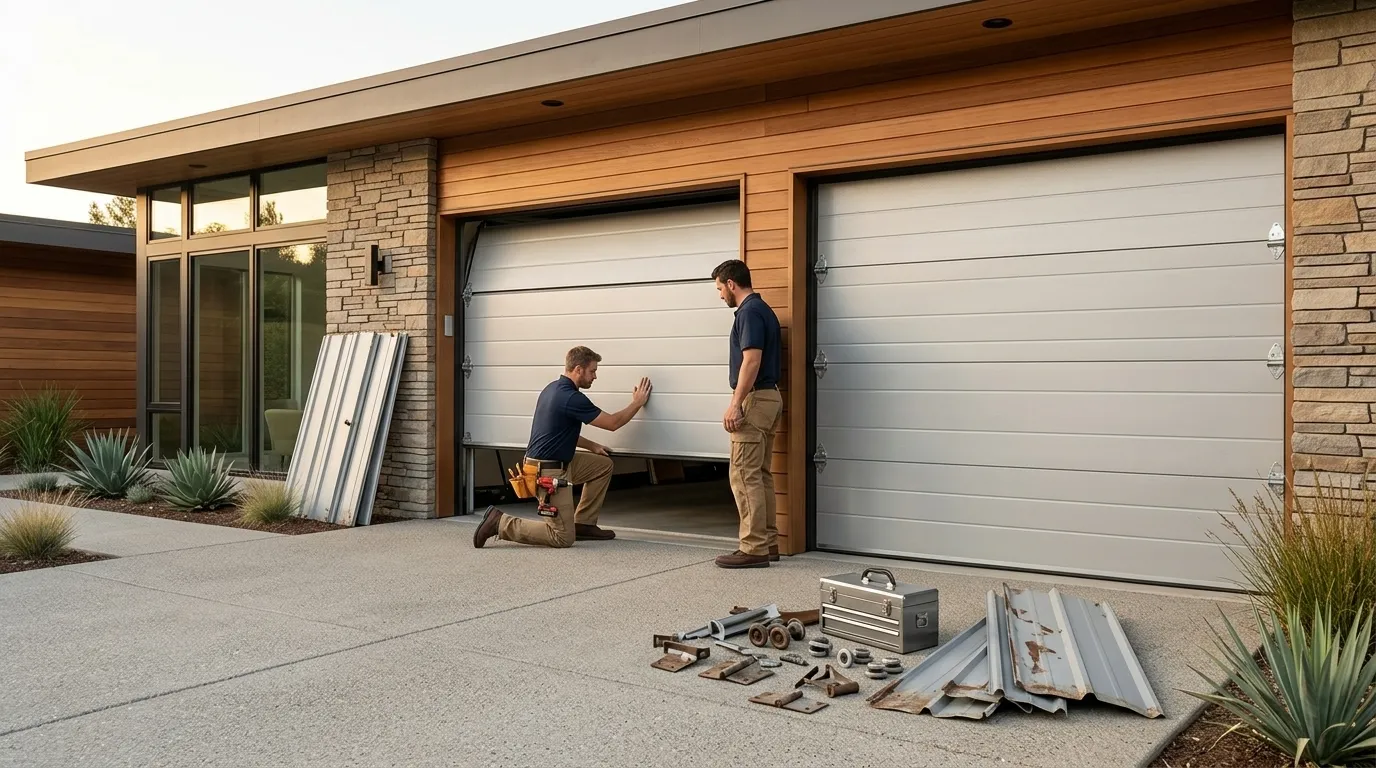
A house built in 1983 almost always has a torsion spring setup mounted on a header above the door, not the older extension-spring style with springs running along the horizontal tracks. That's good news for repair - torsion systems are more standardized and parts are easier to source, even forty years on. What's less standardized is the opener. Early-80s to mid-90s chain-drive units used a mix of proprietary logic boards and remote frequencies that don't always play nice with universal replacements, so sometimes the fix isn't a repair, it's a full opener swap. Panel-wise, expect steel sectional doors, often with minimal insulation since insulation wasn't a selling point yet in this build era. If your door feels heavy to lift by hand or the opener strains on the way up, that's usually a spring that's lost tension, not a motor problem - worth checking before anyone replaces a working opener.
Aloha's housing matches the wider pattern of homes built 1964 through 2006 with a median around 1982, but locally the center of gravity sits at 1983 - squarely in the era of single-story ranches and split-level layouts built for growing Washington County suburbs. These are attached two-car garages, standard 16-foot double doors or paired single-car doors, built to a code that didn't yet require the wind and insulation specs you'd see in newer construction. With roughly 18,790 households in the area, and a median household income of $96,754 - below the wider service area's $102,931 - most homeowners here are working with the original garage structure and, in a lot of cases, the original door, just with replaced springs and hardware over the years. It's not glamorous work, but it's consistent: the same generation of house needing the same generation of fix.
The contrast matters most when you compare Aloha to the inner Portland neighborhoods we also cover. Places like Buckman or Hosford-Abernethy, a couple miles south of downtown, have garages that predate almost everything in Aloha - different framing, different hardware, sometimes doors that were never designed for an automatic opener at all. Aloha skews newer and more uniform: fewer surprises, fewer custom retrofits, more doors that fail in the ways you'd expect a 40-year-old torsion spring or a tired chain-drive opener to fail. The climate here runs mild with occasional freezes, so we're not dealing with the frost-heave or extreme-cold cracking you'd see in colder states - the wear here is mechanical fatigue, not weather damage. One limit worth naming: we don't stock every discontinued opener logic board from the 80s and 90s, so on rare occasions a full opener replacement is faster and cheaper than hunting down an exact part match.
Yes. Aloha's housing centers on a median build year around 1983, while inner Portland neighborhoods like Buckman have garages decades older. That means Aloha doors are almost always torsion-spring systems on standardized openers from the 80s-90s, not the extension-spring setups or retrofitted openers you find closer to downtown.
Opener logic boards from the early 80s through mid-90s age out mechanically, not just electrically. If yours has been repaired more than once, the board itself is likely near the end of its life. At that point a full opener swap usually costs less over time than repeated part-by-part fixes.
The area sits in a mild climate band with occasional freezes, not the deep-freeze cycling that cracks seals and warps panels elsewhere. Most of what we see here is straightforward mechanical wear from decades of use, not weather damage to the door or track.
Call now or request a free quote - same-day service on most repairs, upfront written pricing.