If you're looking at installation instead of a spring fix, it usually means the door itself has run its course. A lot of Portland garages still carry what went in when the house was built - and across this service area that's mostly 1964 to 2006, with the median landing around 1982. That means single-layer steel with no insulation, seals that have gone brittle, and hardware sized to a code that's decades old. You'll see a door that's heavier to lift than it should be, panels that have rusted along the bottom where water sits, or a track that's been reworked so many times the door doesn't sit square anymore. Sometimes it's simpler than that: the opener is original, the door is original, and neither one talks to the other the way a modern setup does. None of that is a spring problem or a cable problem. It's a door that's aged out, and patching it again just delays the same call. When the panel itself is the issue - not what's turning it - installation is the honest answer, not another repair.
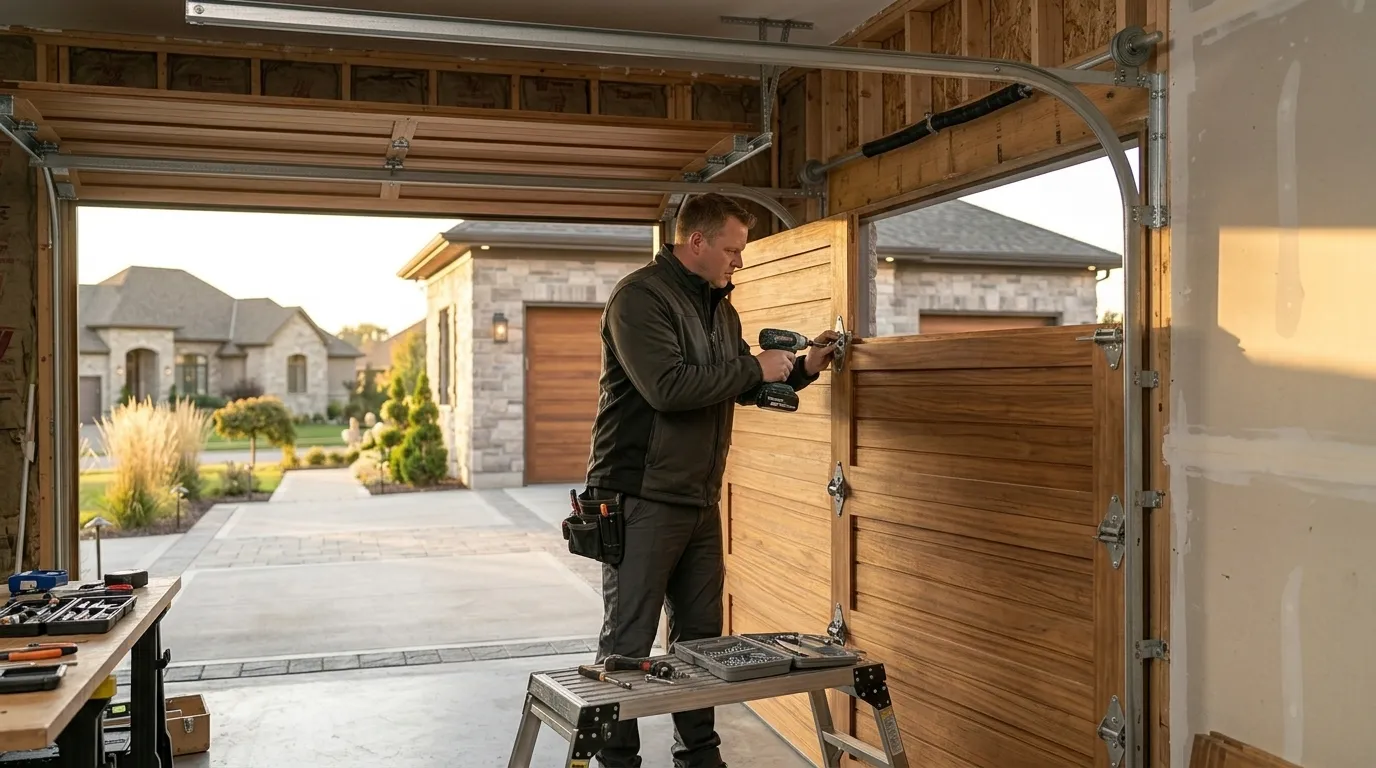
A single-car steel door without an opener is within reach for someone comfortable with a drill and a level - the panels aren't heavy on their own, and the hardware is bolt-together. The problem shows up at the spring. Torsion springs on a new install carry real tension, and winding them without a properly sized bar, or guessing at the wind count for a door your garage was never built for, is how people end up in the ER, not how they end up with a working door. Sizing is the other trap: openings on houses from the 1964-2006 stretch aren't always standard, and an off-by-an-inch track means a door that binds or won't seal against the mild, occasionally freezing weather we get here. If you've done this before and have the tools, a basic single door is doable. A double door, an insulated door, or anything with an opener wired into it - that's where we'd tell you to call rather than improvise. We won't talk you into a job that's simple, but we also won't pretend the heavy jobs are beginner work.
We measure the opening as it actually sits, not as the door label says it should be - plenty of these openings have settled or been reframed over the decades. From there we spec a door built for this climate band: mild most of the year with real freeze nights mixed in, which means weatherstripping and a bottom seal that won't crack the first cold snap. For most of what we install, that lands on insulated steel or composite rather than a bare single layer, since that's what holds up against the swing between a warm afternoon and a freezing night without warping the panel. We pull the old door and track completely rather than bolt a new door onto old hardware - mismatched wear between new panels and a worn track is exactly what shortens the life of a fresh install. Springs, cable, and rollers all get sized to the new door's actual weight, not carried over from whatever was there. One limit worth saying plainly: full custom colors, full-view glass, and specialty carriage builds are special-order items, and they take longer than a standard steel door off the shelf.
The short version is the age of the housing stock. A door installed when a house went up in the 1960s through the mid-2000s was built to the standards of that decade, and across the 30-odd named areas we work in - from the Pearl District and Buckman out through Tigard, Milwaukie, and Gresham - that means a lot of doors are running well past what they were designed for. Add the climate: this is a mild band with some freeze mixed in, not deep winter, but enough that a door without real weatherstripping takes damage slowly, season after season, until the seal fails and the panel starts to sag or rust at the bottom edge. It's not one storm that does it. It's forty-plus years of a garage door built for a different set of standards absorbing whatever the season brings. With roughly 101,547 owner-occupied houses in our service area, and a median income here that tends toward better-built doors when people do replace, we see the same pattern across neighborhoods that otherwise look nothing alike: old door, mild climate, slow failure, and eventually a call for a new one instead of another patch.
If the panel itself is rusted, warped, or cracked - not just the spring or opener - replacement is usually the better call. A door built in the 1960s through the 1990s often has no insulation and worn-out seals that no repair fixes. We'll tell you honestly if a repair would hold, but a door that's failing at the panel level won't get better with a patch.
Yes. A lot of houses in this service area were built before doors were sized the way they are today, and openings have sometimes shifted with the house. We measure the actual opening rather than assume it matches a standard size, and size the door and track to that.
For a climate that's mostly mild with some freeze nights mixed in, an insulated steel or composite door with a proper bottom seal holds up better than a bare single-layer door. It handles the swing between a warm afternoon and a cold night without the panel warping or the seal cracking early.
We can, but those are special-order items and take longer than a standard steel door we'd have ready off the shelf. If timeline matters more than the specific look, a standard insulated door is the faster route.
Call now or request a free quote - same-day service on most repairs, upfront written pricing.