Most calls start the same way: the door stops halfway and won't move either direction, or you hear a loud bang from the garage and now nothing happens when you hit the remote. That bang is almost always a torsion spring letting go. Other common ones - the door creeps off its tracks on one side, a panel is visibly bowed or dented from a car bumper, the opener motor runs but the door doesn't budge, or the door reverses itself halfway down for no clear reason.
A lot of what we see in Portland traces back to age. Houses in this service area were mostly built between 1964 and 2006, with a lot of that stock landing around 1982. That means the spring, the cable drums, the rollers, and sometimes the opener itself are original or close to it - 30, 40 years old on the low end. Metal fatigues. Cable strands fray. Nylon rollers crack and get noisy long before they fail outright. If your door is groaning, slamming, or sticking, it's usually not one dramatic failure - it's years of wear finally catching up with hardware that was never meant to last this long.
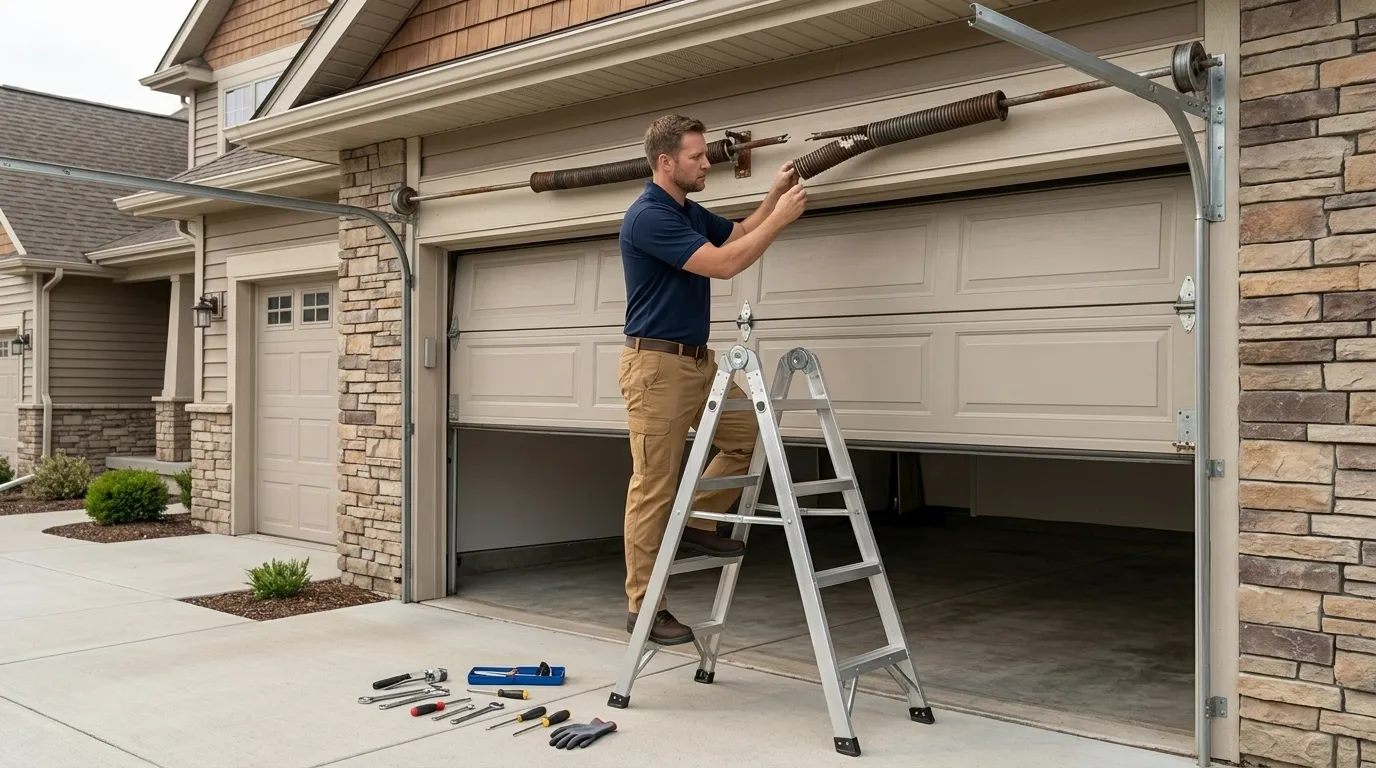
Some of it, yes. You can check whether the remote or wall button has a dead battery, look at the track for visible dents or gaps, tighten loose bolts on the hinges, and clean off years of grime on the rollers. Weatherstripping along the bottom is also a reasonable DIY swap if it's just cracked and letting in drafts.
Here's the honest limit: torsion springs are wound under enough tension to break a bone or worse if they let go while you're working on them. We don't recommend homeowners touch spring adjustment, spring replacement, or cable work, full stop - this isn't us protecting a service call, it's just how the hardware behaves under load. Same goes for anything involving the torsion bar itself. If the fix means unwinding or rewinding a spring, that's a call for someone who does it daily, not a Saturday project. Everything else - cosmetic panel scuffs, a squeaky hinge, a loose remote clip - is fair game if you're comfortable with a ladder and a wrench.
We start by watching the door run, not just looking at it sitting still - a lot of failures only show themselves in motion, like a cable that's slightly unspooling or a track that's a quarter-inch out of plumb. Once we know what's actually failing, we replace the specific part: a matched torsion spring sized to your door's weight, worn rollers, a frayed cable, or a burnt-out opener circuit board.
We don't push replacement when a repair will hold. But on some of the older doors in this area - original 1960s through 1980s builds - the door itself is thin enough or dented enough that patching one more part isn't worth it, and we'll tell you that instead of billing for a repair that won't last. That's the trade-off with hardware this age: sometimes the smart move is one clean fix, and sometimes it's telling you the door has had a good run and it's time to talk about a new one.
Two things are working against garage doors here: the age of the housing stock and the climate. With most homes going up between 1964 and 2006 - median around 1982 - across the 30-plus areas we work in, a huge share of the torsion springs and cable drums out there are original equipment nobody has touched since the house was built. Springs are rated for a set number of open-close cycles, and thirty-plus years of daily use runs most of them past that rating quietly, until one gets brittle enough to snap.
Portland's climate compounds it. The band here is mild with occasional freezes rather than harsh winters, but that swing between damp and cold is exactly what corrodes exposed steel - rollers, cable ends, spring coils - over time, and the occasional freeze snaps a spring that's already fatigued from rust and cycle count. In neighborhoods like Overlook, Concordia, and Buckman, where 1980s and 90s construction is common, we see that rust-then-snap pattern often enough that it's not a coincidence - it's the local weather working on hardware that's been out there since the house was new.
There's no fixed number, but springs are rated for a set number of open-close cycles, not years. Since a lot of Portland homes were built between 1964 and 2006 with the original hardware still in place, a spring that's 20-plus years old and getting noisy or slow to lift is worth having checked before it breaks on its own.
Portland's winters are mild but do dip below freezing at times, and that cold snap is often what finally breaks a spring that's already worn from age and rust. The cold doesn't cause the wear - it's usually the last straw on hardware that's been fatiguing for years.
We work across Portland, including Buckman, the Pearl District, Concordia, Overlook, Downtown, Hosford-Abernethy, Rose City Park, Mount Tabor, Sunderland, Cully, and Brooklyn, plus the wider service area out to places like Cedar Mill and Gresham.
Sometimes, yes. If the door itself is heavily dented or the panels are original from a 1960s-1980s build and thin from age, patching one more part often isn't worth the cost. We'll tell you straight if replacement makes more sense than another repair.
Call now or request a free quote - same-day service on most repairs, upfront written pricing.