Most calls we get start the same way: the door won't budge, or it slams down the last foot of travel with a bang that shakes the wall. Sometimes it's a cable that's jumped its drum, or a torsion spring that's let go overnight with a crack loud enough to wake the house. On older doors you'll see a spring with a visible gap where it's snapped clean through - that's a spring at the end of its rated cycle life, not a fluke.
A lot of Portland's housing stock went up between 1964 and 2006, with most of it dating to the 1980s and 90s across the metro's named areas. That means a huge number of original torsion springs and openers are now thirty to forty years old, well past the point where failure is a surprise. If your opener grinds, reverses on its own, or the door hangs crooked on one side, that's usually a cable or roller problem feeding off the same worn hardware, not the opener itself failing.
We also see doors that open fine but rattle or shudder on the track - track misalignment from years of small bumps, or rollers that have worn oval instead of round. None of this is dramatic until the day it is, which is why we treat a slow-closing door as a real symptom, not a nuisance.
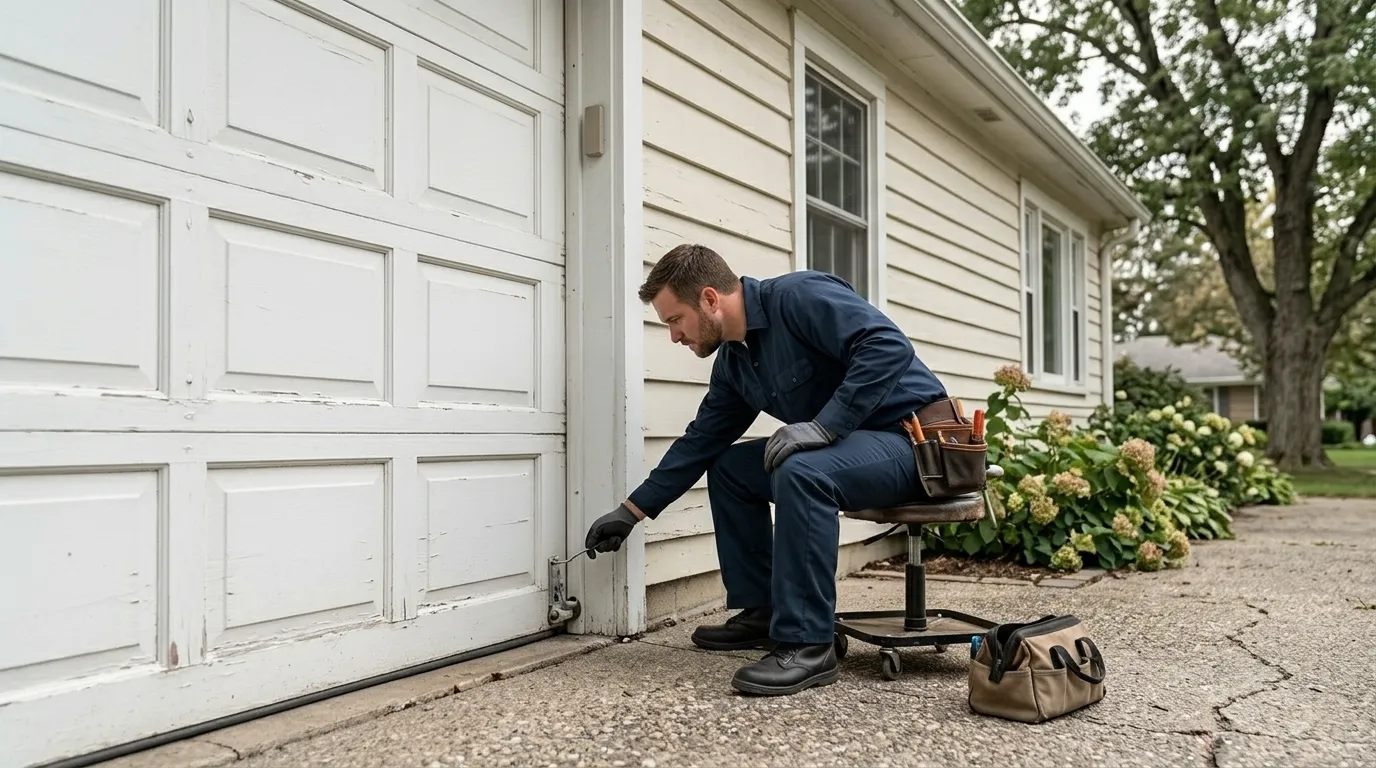
Some of this is safe to check yourself. Look at the springs above the door - if you see a visible gap, stop there and don't try to open the door manually. Torsion springs hold enough stored tension to break a hand or worse, and that's true whether the spring is six months old or thirty years old like a lot of what we find on original garage doors in this area.
You can safely check and tighten loose hinge bolts, clean debris out of the track, and test the auto-reverse safety feature by placing a piece of wood under the door and running it down. If it doesn't reverse, that's a real safety issue and worth a call regardless of anything else going on with the door.
What you shouldn't do yourself: touch the torsion spring, the cables, or anything under load. We won't talk you through that over the phone, and we'd tell you the same thing if you called - it's not a job for one person with a wrench and no experience, and the injury risk isn't worth the money saved. If the door is original to a house built decades ago, assume the spring is near end of life and get it looked at before it lets go on its own.
For a broken torsion spring, we match the spring to the door weight and cycle rating rather than grabbing whatever's closest - a mismatched spring wears out fast or throws the door off balance. Cables get replaced in pairs on double doors, not one at a time, since a mismatched cable set is what causes the next failure.
On track misalignment we re-set the track to plumb and square rather than just bending it back by eye, and we swap worn rollers while we're in there since they're cheap compared to a second trip. If the opener itself is the problem - grinding gears, a stripped drive gear, or a motor that's simply tired after decades of use - we'll tell you straight whether a repair makes sense or whether replacing the opener is the better spend, given how old a lot of this equipment is across houses built in the 1980s and 90s.
One honest limit: we don't stock every obsolete opener control board or every discontinued spring size, so if your door or opener is an unusual original model, there can be a short wait on a part. We'll tell you that up front instead of guessing at a timeline.
Portland sits in a mild climate with occasional freeze, and that combination is harder on garage door hardware than either extreme heat or hard winters. Springs and cables go through repeated damp-then-dry cycles most of the year, which speeds up surface rust on unsealed coils and cable strands - rust you often can't see until the spring is already weakened. A hard freeze snap on top of that dampness adds stress to metal that's already fatigued.
Combine that climate pattern with a housing stock where most homes were built between 1964 and 2006, median around 1982, and you get a large share of garage doors running on original or first-replacement hardware that's now decades past a reasonable service life. That's true whether the house sits in the Buckman area a mile from downtown or out toward Cedar Mill seven miles northwest - the age of the housing, not the neighborhood, is what drives the failure pattern we see.
If your door was installed when the house was built, the spring, cables, and rollers are very likely original, and age alone - not any one bad day - is usually the real cause.
Springs are rated by cycle count, not years, but most residential torsion springs are engineered for roughly 7-10 years of typical use. In a metro where a lot of housing dates to the 1964-2006 range, median around 1982, plenty of doors are still running original springs decades past that window.
Portland's mild-with-occasional-freeze climate means metal hardware cycles through damp and dry conditions most of the year, which promotes rust on springs and cables. A cold snap on top of that adds extra stress to metal that's already weakened, which is often when a marginal spring finally lets go.
Depends on the fault. A stripped gear or a bad capacitor is usually worth repairing. If the opener is original to an older house and the motor itself is worn out, replacement is often the better spend, and we'll say so rather than patch something that'll fail again soon.
Not always. If your opener or spring size is an unusual original model, there can be a short wait to source the part. We'll tell you that up front rather than guess at a timeline once we're on site.
Call now or request a free quote - same-day service on most repairs, upfront written pricing.