Boring sits about 15 miles out from Portland, making it one of the farther stops on our route, and the calls we get from out here look different from the ones closer in. With roughly 578 households spread across a more rural layout than the close-in Portland neighborhoods, garages tend to sit further from the house and get used harder - for trucks, trailers, mowers, and shop equipment, not just the family car. That means more wear on rollers and hinges from daily open-close cycles, and springs that have done more total lifts than a door in a denser neighborhood might see in the same number of years. We still see the standard failures - broken torsion springs, snapped cables, openers that grind instead of lift - but the wear patterns skew toward hardware that's been asked to do more physical work per household. It's worth saying plainly: because of the drive, we can't promise a same-hour arrival out here the way we might for a call a mile from our route. We schedule Boring jobs realistically around the trip, not around an emergency-response line we can't back up from this distance.
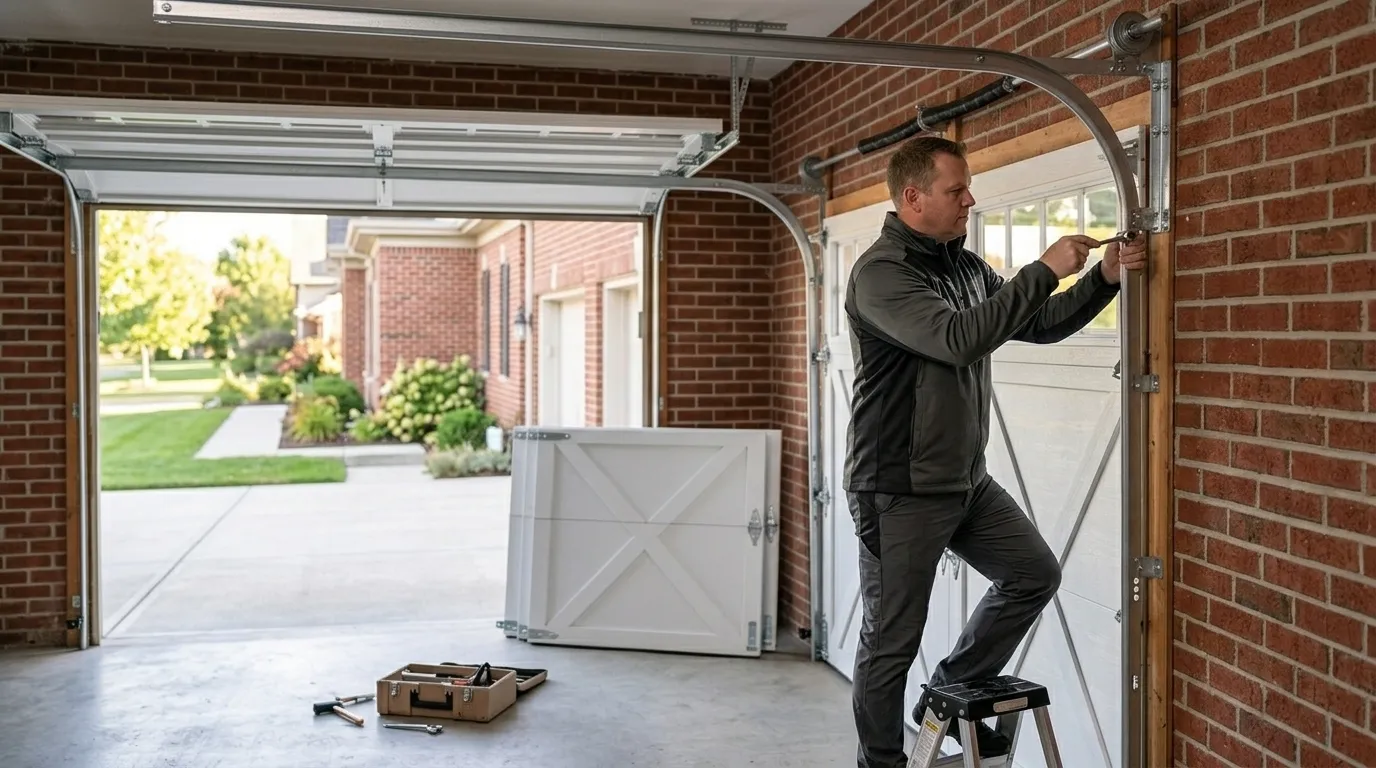
With a median build year of 1982 for homes in Boring, a lot of the doors and openers out here are original or close to it. That's an important detail, because 1982 hardware is not 2010 hardware. Early-1980s garages commonly ran chain-drive openers, single-layer steel doors without much insulation, and torsion springs sized for lighter, thinner panels than what's sold today. When a spring on one of these breaks, we're often not swapping in an identical replacement - we're sizing new hardware to the door that's actually there, which sometimes means the whole spring assembly needs updating rather than a like-for-like part. Openers from that era also used control boards and safety-reversal systems that don't match anything on shelves now, so a failed circuit board on an 80s-era opener is usually a full opener replacement rather than a repair. We'll always tell you which one you're looking at before we start work, not after.
Boring's housing stock centers on that 1982 median, which lines up with the broader pattern across this service area: homes going up mainly between 1964 and 2006, with the heaviest concentration in the 1980s and 90s across the thirty-some communities we cover. Boring falls on the far edge of that range geographically, at roughly 15 miles from Portland, putting it well outside the tighter cluster of close-in neighborhoods like Buckman or the Pearl District that sit a mile or two out. What that means in practice is a garage door population here that skews toward mid-80s originals, with a smaller share of newer builds mixed in compared to some of the closer-in areas. Median household income in Boring runs around $101,250, close to the wider service-area figure of $102,931, which tends to track with owners choosing a solid opener replacement and a properly sized new door over patching failing 40-year-old hardware indefinitely.
There isn't a sharp old-versus-new line in Boring the way there might be in a neighborhood that got a wave of teardown-and-rebuild construction. Most of the housing here dates from the same general era, clustered around that 1982 median, so the split is less about neighborhood block and more about which houses have already had a door or opener replaced versus which haven't. Because Boring is the outer edge of a coverage area that runs from a 1-mile radius in Buckman and the Pearl District out to 19 miles in Scappoose and Canby, a truck heading here is already committed to the longest drive of the day, which is part of why we plan these jobs rather than treat them as walk-up stops. On the repair side, that means we try to diagnose thoroughly over the phone first, so the parts on the truck match what a 1982-vintage door in Boring is actually going to need, rather than making a second trip.
No. We operate out of Portland and drive out to Boring for every job, about 15 miles each way. We're upfront about that because it affects scheduling - we plan Boring calls into the route rather than treating them as instant-response stops.
Circuit boards in openers from that era weren't built for a 40-plus year service life, and once one board fails it's often not a stocked replacement part anymore. For a lot of Boring homes near that 1982 median build year, a dead board means opener replacement rather than a repair.
Not always. Doors from the early 1980s were often lighter than what's manufactured now, so if we're replacing a torsion spring on original hardware, we size it to the door in front of us rather than assuming the old spring was sized correctly to begin with.
We'll always try, but we're driving in from Portland, roughly 15 miles, so we schedule Boring calls realistically instead of promising a response time we can't guarantee from that distance.
Call now or request a free quote - same-day service on most repairs, upfront written pricing.