We drive out to Hillsboro from Portland, about 14 miles, and most of the calls we get out this way are openers on their second or third remote and torsion springs that finally gave out after years of daily cycles. Hillsboro's housing stock skews newer than a lot of the areas closer to the city center, so we're not chasing down the same one-piece wood doors we see elsewhere in the service area. Instead it's steel and composite sectional doors, chain-drive and belt-drive openers from the late 90s and 2000s, and the odd safety sensor that's drifted out of alignment after a settling slab. A fair number of these houses still have their original opener, which by now is well past the point where parts are easy to find. We'll tell you straight when a repair isn't worth it versus swapping the unit.
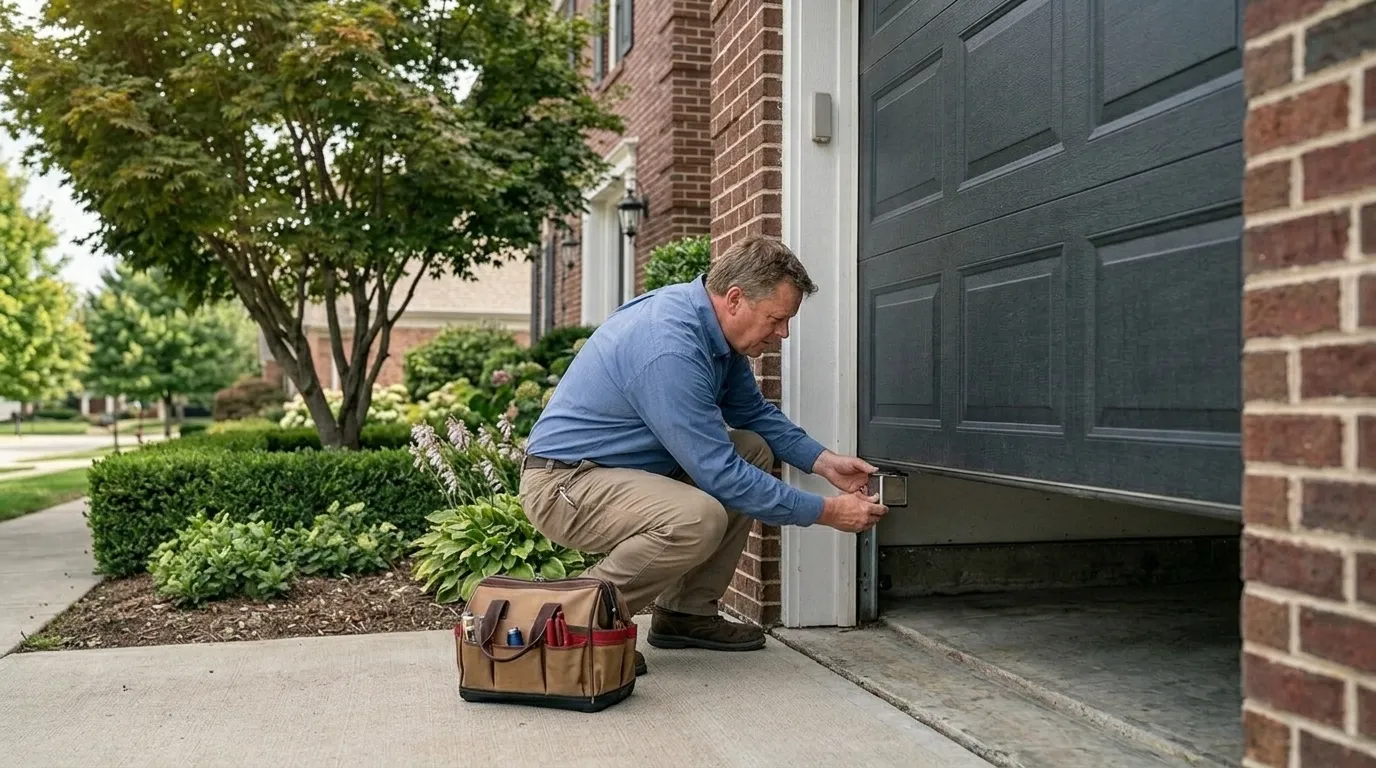
A house built in 1997, which is close to the median build year for this area, was framed for a garage door standard that's different from what you'd find on a 1960s tract house. Panel sizes, track spacing, and the header clearance were all built to a later code cycle, so the doors themselves are usually standard sectional steel rather than the older single-panel or narrow-track setups. What fails first tends to be the opener's circuit board or the drive gear, not the door skin. Rollers on these doors are usually nylon, not the steel ones from older stock, so they're quieter but wear out on a different schedule. When a spring goes on one of these, it's almost always a standard torsion setup, which keeps the repair straightforward - we're not improvising hardware that hasn't been made in decades.
Across the wider service area, home construction runs from 1964 to 2006 with a median around 1982, but Hillsboro sits later than that median at roughly 1997. That twenty-year gap matters more than it sounds like on paper. It means the openers we're pulling out of Hillsboro garages are a full generation newer than what we see in the older neighborhoods closer to Portland, and the failure patterns follow. Circuit boards fail. Belt drives stretch. Steel doors from this era hold up fine structurally but the weatherstripping and bottom seals are usually the first thing to go after two decades of Pacific Northwest damp.
Hillsboro isn't a uniform build year, even if 1997 is the rough center point - there are pockets of older infill and newer construction mixed in, same as most of the 30 named areas we cover. What we're describing here is the typical pattern, not a guarantee for every address. If your house is older than the area median, you might be dealing with the same aging torsion hardware we see closer to the city core, and that's worth mentioning before a technician even shows up. We don't stock every obsolete part for a 1960s door, and being upfront about that saves everyone a wasted trip. Median household income in this area runs around $103,207, and across the broader service area there are 243,751 households with 101,547 owner-occupied houses - Hillsboro is one piece of a large, varied market, not a single housing type.
No. We're based in Portland and drive out to Hillsboro for calls, about 14 miles each way. We don't claim a local depot or a guaranteed response window - we tell you honestly when we can get there.
If your house dates to the area's typical late-90s construction, your original opener may be over 20 years old. At that point parts availability gets thin and replacement is often the more sensible option. We'll look at the specific unit before recommending either way.
Generally yes. Hillsboro's housing stock runs newer than the service area median, so we mostly see standard steel sectional doors and torsion springs rather than the older one-piece doors and obsolete hardware found in some older Portland-area neighborhoods.
Call now or request a free quote - same-day service on most repairs, upfront written pricing.