Milwaukie's housing centers on 1967, about a decade and a half ahead of the 1982 median we see across the rest of the service area. That gap shows up in the calls we get. Houses built in the mid-to-late 1960s were framed for shorter, lighter doors than what gets installed today, and a lot of the original openers and track hardware are still bolted in place, just old. We see extension springs mounted along the horizontal track more often here than the torsion setups common in newer construction, and we see single-layer steel doors that have taken forty-plus years of freeze-thaw cycles on their bottom panels. The work leans toward spring replacement, roller swaps, and opener units that have simply outlived their gears - not the drywall-adjacent new-construction jobs you'd get in a subdivision built in the 1990s. None of this is exotic. It's what happens to a door that has been doing its job since Nixon was in office and nobody's touched the hardware since.
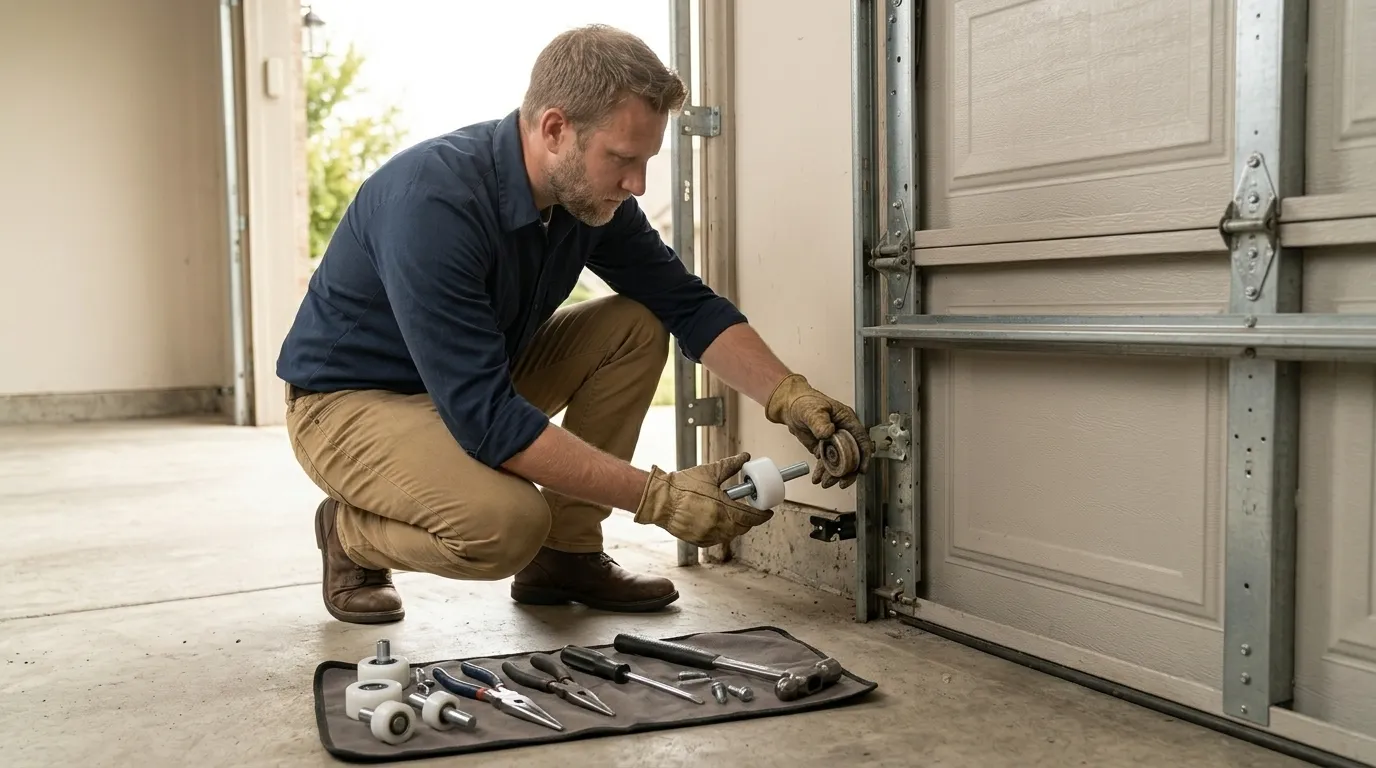
Extension-spring systems from this era don't fail the way modern torsion springs do - they don't snap so much as stretch, sag, and eventually let the door drop unevenly on one side. If your door is heavier on one corner or the cable looks loose at the bottom bracket, that's usually age, not damage. We also run into openers from the 1970s and 80s that are still technically running but have no working reversal sensor, since photo-eye safety sensors weren't required equipment when these units went in. Replacing the opener on a house like this isn't optional if the sensors are missing - it's the one thing we won't leave as-is. On the door side, panels from this build era are often a discontinued profile, so matching a single damaged panel to the rest of the door isn't always possible, and a full door swap ends up being the more honest answer than a patch.
Milwaukie sits about six miles from Portland, and its housing predates the 1980s-90s stock that makes up most of the broader 30-community service area we cover. Across that wider area, 243,751 households and 101,547 owner-occupied houses span a build range from 1964 to 2006, with 1982 as the midpoint. Milwaukie's own numbers run lighter and older: roughly 9,488 households, with a median household income of $82,422, well under the $102,931 average for the service area as a whole. Nearby communities like Oak Grove and Jennings Lodge, both nine to ten miles out, sit in a similar older-build pocket, while newer growth areas further out toward Hillsboro or Sherwood run fifteen-plus miles and a different housing generation entirely.
The practical split in Milwaukie isn't old versus new construction the way you'd frame it in a growing suburb - it's original hardware versus anything that's already been touched once. A door that's had one prior repair, even a basic roller replacement in the last fifteen years, behaves very differently from one that's never been serviced since the house was built. We can't always tell which one we're dealing with until we're standing in front of it, and we won't quote a repair over the phone based on the age of the house alone. What we can say is that the region's mild climate with occasional freeze keeps steel doors from the rust and warping problems you'd see in wetter or colder climates, so a lot of these older doors are still structurally sound even when their springs and openers are done. Replacing the moving parts on a good door usually beats replacing the whole door, but once a bottom panel has rusted through or the track is bent from decades of use, patching stops making financial sense.
Photo-eye reversal sensors weren't required equipment until years after a lot of Milwaukie's housing went up in the mid-to-late 1960s. If your opener predates that requirement, it may never have had them. We treat a missing sensor as a safety issue, not a preference, and recommend replacing the opener rather than working around it.
Extension springs mounted along the horizontal track were standard on houses built around Milwaukie's 1967 median, before torsion setups became common. It's original equipment, not an error. They're a valid system, but they wear differently than torsion springs and are worth inspecting yearly given their age here.
Not always. Doors from Milwaukie's build era often use panel profiles that are no longer manufactured. We'll check what's available, but if the match isn't close, we'll tell you honestly rather than sell you a mismatched panel, and talk through whether a full door replacement makes more sense.
Call now or request a free quote - same-day service on most repairs, upfront written pricing.